Cursed
Bride of AlvarCursed are supernatural beings whose human appearance conceals an innate darkness and a monstrous transformation. The narrative first presents them as objects of public terror, then complicates that image through Alvar, whose Cursed body is exploited by Saul and whose condition becomes inseparable from questions of blame, inheritance, healing, love, and political legitimacy.
Definition and Public Image
A palace artwork depicts a black dragon with red eyes breathing fire into a fleeing crowd; some victims burn while others already lie dead. The painting was commissioned by Saul to inspire fear and identified as an image of a Cursed. This representation establishes the creature through spectacle: fire, mass death, and a body that appears beyond ordinary natural limits.
The distinction between a Cursed and a Drakon is essential. Fletch explains that Drakon are ordinary dragon-beasts that can be killed, whereas Cursed resemble dragons but are unnaturally indestructible supernatural beings. Leeza gives the more intimate account: Cursed are creatures of darkness from birth, capable of a hideous transformation that makes their inner nature visible. They may look like ordinary people, but their appearance is described as a deception concealing what they truly are.
The defining outward sign is not always the transformation itself. Cursed eyes turn red when their bearer becomes stressed. This small, visible change turns emotional pressure into evidence of identity. Lucy notices Alvar’s eyes becoming red and concludes that he is one of the Cursed even before he confirms it, while the people around him fail to see what she sees. The red eyes therefore function as both bodily symptom and social danger: a private loss of control can become a public revelation.
Blood, Healing, and Reproduction
The Cursed state is also connected to blood rather than confined to a visible monster form. Alvar tells Lucy that she has Cursed blood because Cursed blood was infused into her veins while she was still in her mother’s womb. Her mother had promised Lucy to Alvar if he saved the unborn child, and the infusion healed a developing fetus that otherwise would have died. In Lucy’s case, the blood does not make her transform into a monster; as far as Alvar knows, it gives her unusually rapid healing compared with most mortals.
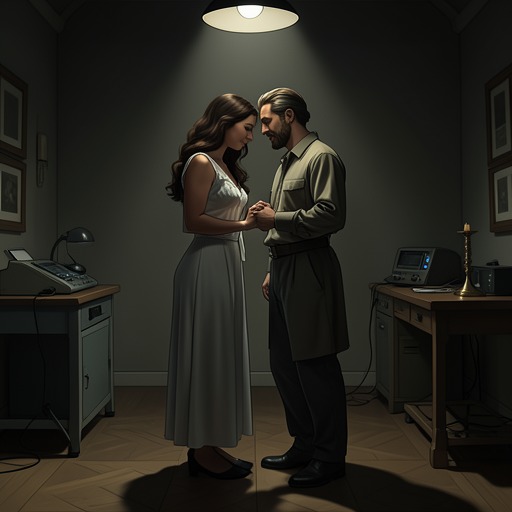
This medical and hereditary dimension changes the meaning of Lucy’s marriage arrangement. Alvar says that she is the only person he knows with certainty who can carry his children without dying, making her the only compatible Earth choice for a treaty marriage. His explanation is not presented as a simple romantic destiny. It joins bodily survival to diplomacy, fertility, lineage, and the political needs of Underland. The same blood that saves Lucy also makes her valuable within a monarchy concerned with heirs.
Pregnancy has already produced a devastating precedent. Alvar accepts responsibility for Triss’s death, explaining that she had no Cursed blood and that he destroyed her by getting her pregnant because he did not understand how Cursed pregnancies worked. Later, a physician identifies Lucy’s pregnancy crisis as a magical problem caused by a dark Curse. The repeated association between Cursed blood and pregnancy turns reproduction into a site of medical uncertainty and moral guilt, while Alvar’s research with multiple record keepers, including Father Ryland, supplies the basis for his belief that Lucy could survive bearing his children.
Lucy is saved again through this bodily connection after her confrontation with Saul. Her mother explains that Alvar gave Lucy his Cursed blood once more, just as he had done before her birth, and that the transfusion is what keeps her alive. Cursed blood therefore carries two contrary meanings: it is feared as the substance of monstrosity, yet it is also the means of healing and survival.
Alvar and the Politics of Enslavement
Alvar is the story’s central embodiment of the Cursed condition. He reveals to Lucy that he is the Cursed Saul used to gain power. Before he became ruler, Saul enslaved him through a Fe collar, a device of dark magic whose wearer can be controlled by whoever possesses its key. Alvar continues to wear the invisible collar as a mark of shame, a constant reminder that he was enslaved even when the device cannot be seen.
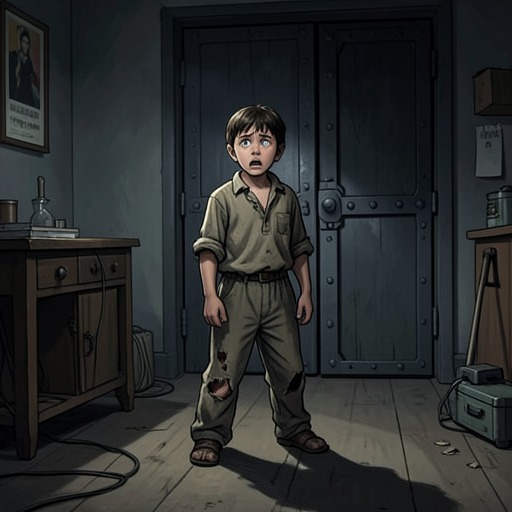
This history separates the Cursed identity from the violence attributed to it. Alvar admits that he was the instrument of Saul’s death-dealing and that he performed terrible acts, but he insists that the collar deprived him of choice. When he later confesses publicly, he explains that his family expelled him as a young boy after discovering the Curse, leaving him vulnerable to Saul’s exploitation. Saul did not merely command a monster; he found a stigmatized child, converted fear of his body into a mechanism of control, and made that body serve tyranny.
The collar also makes the Cursed form politically legible. Alvar’s transformation is not simply an eruption of personal evil but the visible consequence of a system in which another ruler possesses the power to command him. Saul can still summon the transformation by holding up the collar’s key and ordering Alvar to obey. Alvar shakes, falls, and resists, but the command finally forces him fully into his Cursed form, destroying the room as his body expands.
Transformation and Physical Form
The transformed Cursed body is presented through escalating stages of fear. At first the threat is discussed through paintings and warnings, allowing imagination to enlarge what has not yet been seen. The revelation at Ferar replaces anticipation with direct horror. Lucy sees a creature larger than any living land animal on Earth, perhaps comparable only to an extinct sauropod dinosaur. Its jagged black wings spread aggressively, its jaws snarl around sharp white teeth, its red eyes glare at the gobli who removes Lucy’s restraints, and a scar runs up the side of its serpent-like face.
The scene makes the contradiction between husband and monster physically unavoidable. Lucy recognizes that the terrifying creature is her husband, and the palace paintings had failed to convey the full terror of his angry appearance. The Cursed body is therefore not an abstract symbol: it has scale, wings, teeth, a scar, and the power to overwhelm a landscape. Yet its identity remains relational. The monster is frightening precisely because it belongs to the man Lucy knows and loves.
Alvar’s public revelation repeats this transformation under controlled conditions. Before Lord Vessin, Alvar removes his shirt and allows a gunshot to strike his exposed chest. The wound heals almost immediately, his eyes blaze red, and his body begins changing as his bones break and expand. His transformation crushes the podium and shatters the cathedral windows, while the crowd responds with screams and Vessin fears that Alvar will kill everyone present. The demonstration exposes both his regenerative body and his willingness to make himself vulnerable in order to force his people to confront the truth.
When Saul later compels the change, the transformation is stripped of that agency. Alvar fights the command, releases Lucy, collapses in pain, and finally becomes the beast Saul wants others to see. This contrast distinguishes self-disclosure from enforced monstrosity: in the cathedral Alvar chooses to reveal himself, whereas in Saul’s chamber his body is again being used as an instrument of domination.
Breaking the Monster’s Binding
The Cursed condition is not ended by persuasion or by Lucy’s love alone. Saul explicitly tells Lucy that she cannot love Alvar into breaking the binding, then uses the key to command him. Alvar’s resistance demonstrates that his human will remains present, but the Fe collar’s control is stronger until its physical source is destroyed.
During the struggle, Lucy cuts herself deeply and uses the resulting blood and fire-filled chaos to free herself. She reaches Alvar’s transformed body, forces the stolen key into the collar, and turns it. The collar falls and melts into a blood-like pool. Once the binding is broken, the flames vanish and Alvar’s monstrous form folds back into that of a man, though he collapses from the strain.
The destruction of the collar changes the political meaning of the Cursed body. Alvar is no longer merely Saul’s weapon, but liberation does not erase the physical and psychological consequences of enslavement. His shame, guilt, and fear of rejection remain, and the story continues to treat humanity as an ongoing struggle rather than a condition guaranteed by appearance.
Stigma, Love, and Continuing Threat
Alvar’s family rejected him because of the Curse, and he fears that Underland will do the same. When Saul identifies him as Cursed, Alvar experiences the words as a wound and thinks that he will never have a home or be accepted. His secrecy is therefore a form of survival. He hides the collar, conceals the transformation, and withholds his origins because he fears that disclosure will cause his people to shun him and abandon his mission to free Underland.
The public confession begins to break that pattern, but acceptance remains unstable. Some people insult Alvar and rise from their seats, while others restrain them or remain silent. The divided response shows that revelation does not produce a single moral conclusion. The community must reconcile the terrifying body, the historical violence associated with it, and the fact that Alvar was also enslaved.
The Cursed state continues to threaten Alvar’s future even after the collar is destroyed. He admits that it is taking increasing effort to remain human and that stress makes it harder to contain the beast. He urges Lucy to distance herself, calling her Queen Lucy, the Fireblood, slayer of the tyrant, and rescuer of Axus, as though her public identity might survive only if separated from him. The creature’s final significance is consequently unresolved: the Cursed is neither simply an evil monster nor merely an innocent victim, but a body through which the story tests whether love, political recognition, healing, and moral responsibility can coexist with an inherited and visibly feared difference.